
Jack Greynolds GRIT Award and Memorial Scholarship
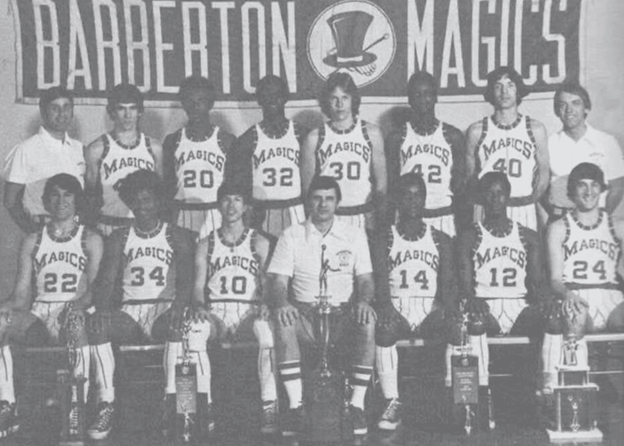
Left to right, top row: Coach Joe Suboticki, Kevin Stull, Carter Scott, Tony Ward, Jim Graham, Harold Grisby, Jim Stocker, Coach Ralph Pim.
Seated: Mark Bodnar, Jerry Vaughn, Rick Jacobs, Head Coach Jack Greynolds, Fred Grisby, Vance Cheatham, Marty Bodnar
The 1976 Championship: A Legacy of Grit and Magic
The Jack Greynolds Memorial Scholarship honors the legacy of one of Barberton’s most transformative and beloved figures: Coach Jack K. Greynolds, a man whose impact extended far beyond the court and into the lives of his players, the fabric of the community, and the story of Barberton itself.
There are moments in Barberton’s history that feel larger than life, and the 1976 Barberton Magics basketball team is one of them. They didn’t just win games. They electrified a city. They made Barberton believe. They became the stuff movies are made of.
Fans lined up outside the Industrial Arts Gymnasium hours before tipoff. Businesses streaked “Go Magics!” across their windows. After big wins, cars flooded Hopocan Avenue honking and cheering in purple pride.
As lifelong fan Randy Forst said, “Basketball saved Barberton through the seventies when the factories were closing. Three dollar tickets, one dollar hot dogs. There was a synergy back then.”
In a time when uncertainty hung in the air, this team gave the city something powerful: hope.
Fifty years later, their story is still shared like a hometown password, the kind of thing people mention in barber shops, locker rooms, and corner bars to mark where they were, who they knew, and how deeply Barberton runs in their veins.
Today people say, “I went to school with the Bodnars,” or “I was in the stands the night they lost to Alliance,” or, “I never missed an open gym.” And finally, “I knew Jack Greynolds.”
The Man Behind the Legend
Before the trophies and purple-painted windows, before doughnuts were dyed purple and street names temporarily changed to honor players, there was Jack — a quiet, deeply thoughtful student of the game who arrived in Barberton in 1969 ready to reshape what high school basketball could look like.
His path to Barberton was almost accidental. He had built Revere High School into a regional contender beginning in 1957, and in 1969 one of Jack’s assistant coaches secretly submitted Jack’s application to Barberton, sensing that Jack’s approach was exactly what the Magic City needed.
When Jack arrived, he said simply, “I am going to make Barberton a basketball town,” and he meant it.
He was intense, demanding, relentless, and absolutely devoted to the young people in his care. As his son Jack, Jr. said, “People saw the yelling. I saw the man who tucked me in at night and prayed with me.”
Randy Forst added, “He yelled, but it was never personal. He took coaching more seriously than ninety-five percent of high school coaches. Wherever he was, he believed it was the most important job in the world because of the kids, the fans, and the city.”
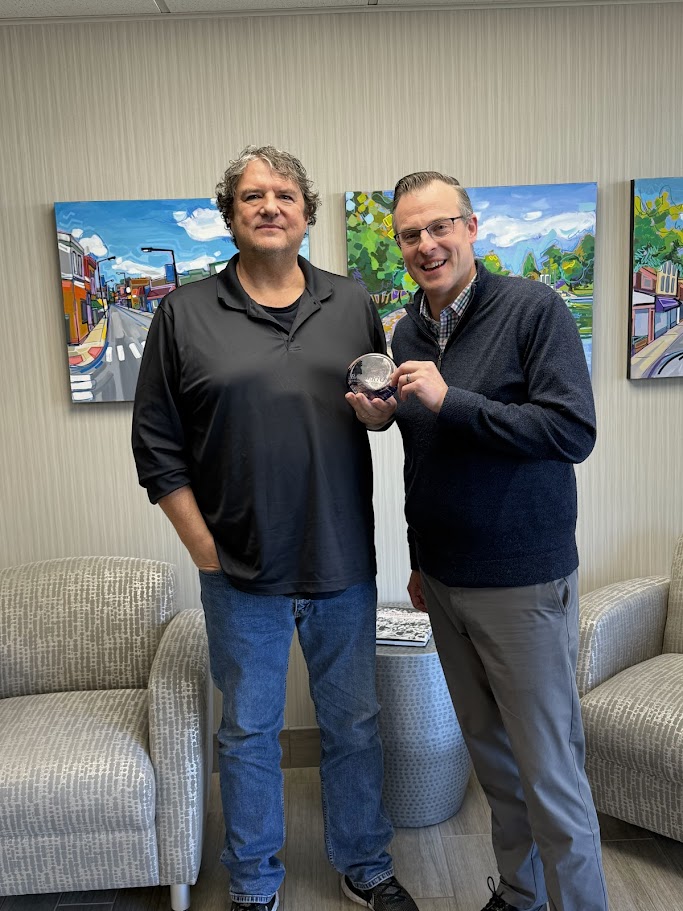
Jack Greynolds Jr. and Josh Gordon, Barberton Community Foundation, establish the fund for Jack Greynolds Memorial Scholarship.
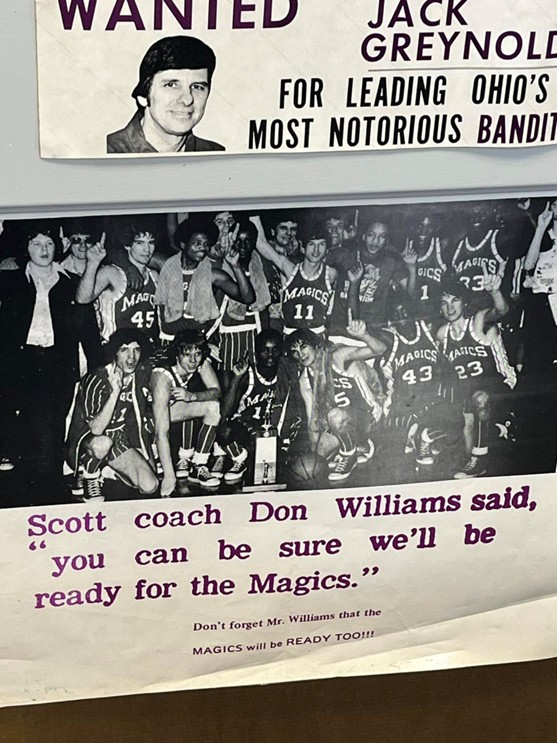
Yearbook photo from 1976 reads: “WANTED Jack Greynolds For Leading Ohio’s Most Notorious Bandits” and below, “Scott coach Don Williams said, ‘You can be sure we’ll be ready for the Magics.’ Don’t forget Mr. Williams that the MAGICS will be READY TOO!!!”
The Coach Who Changed Everything
High school basketball in 1969 was slower, more deliberate, and built around half-court sets. Most teams played slowly, walking the ball up the court. There was no three-point line and final scores rarely reached 50.
Jack changed that. He introduced the full-court press to the Akron area, pushed the tempo, conditioned players like college athletes, and visited Barberton’s parks — Tuscora, Edgewood, Elson and Crisman — looking for raw talent.
His practices were legendary. As Roger Cramer, who later succeeded him, once said, “Being at one of Jack Greynolds’ practices was like being at a clinic every night.”
Jack was fair, but never equal, measuring each player by the standard he believed they could reach. He believed that building a team required more than talent. It required grit.
Forst said, “That is his secret,” after watching Jack hold a junior varsity player to the same expectation as a star player. Jack chose players not because they were easy to coach but because he believed in their potential. “He kept the tough kids and helped them be their best,” Forst added.
Former player Tom Brabson, said, “Someone cared about me. My teammates cared. And sure, I hated my coach sometimes, but he changed my life.”
That was Jack’s gift. He didn’t just coach games. He lived and breathed the sport and he believed in the power of a coach to reshape young men into champions with real confidence, a strong work ethic, and a lasting bond.
The Team that Became Magic
Around this time, Barberton was hurting. Sun Rubber closed in 1974, Seiberling Tire was struggling (and would close in 1980), and families were holding their breath for what might come next.
The players grew up within three miles of each other, a crew of kids from different home lives and different personalities who found common ground on the courts at Tuscora Park. They were undersized, scrappy, stubborn, and fearless, and under Jack’s relentless coaching they were molded into something greater than the sum of their parts.
Their roster read: Mark and Marty Bodnar, Carter Scott, Vance Cheatham, Harold and Fred Grisby, Kevin Stull, Tony Ward, Jim Graham, Jim Stocker, Jerry Vaughn, Rick Jacobs, and the steady presence of assistants Joe Suboticki and Ralph Pim — all local boys coached by a man who believed in the power of helping ordinary kids do extraordinary things.
They opened the season with a stunning 122–69 victory. They defeated Canton McKinley in the Regional Final after being down by 10 points at half-time – Harold Grisby led the comeback by going 6 for 6 in the third quarter. They forced 47 turnovers in the state semifinal. They defeated the legendary seven-time champion Middletown in the state final by forcing 28 turnovers, a masterclass in pressure basketball. They finished the season 26–0 and brought home Barberton’s first state basketball championship.
The city erupted in celebration. Cars honked for hours along Hopocan Avenue. Businesses painted their windows purple. Doughnuts were dyed purple. One house was painted entirely purple. As Forst said, “It tied everyone together. It was the right coach, the right city, the right time, the right team, the right gym.”
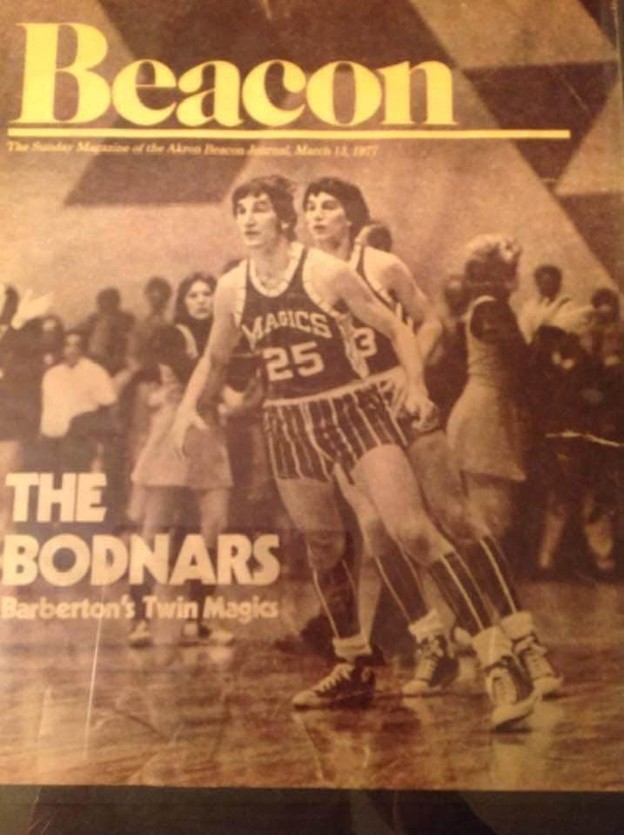
March 1976, Akron Beacon Journal

1976 AAA State Champions Barberton Magics
The Man Beyond the Court
Jack’s presence off the court was nothing like the fiery coach people saw for ninety minutes on game nights. He was gentle, humble, quiet, and deeply faithful. His son said, “They saw him two hours a week in a stressful situation. They did not see him as a man, as a whole person.” At home he read in his home library, which was stacked with books from floor to ceiling. He studied strategy relentlessly, but would also take the time to tuck his son into bed so they could read their Bible and pray each night.
Jack and his wife Mary did everything as a team. She was a health and physical education teacher and came from a family of doctors, which made his 1977 heart attack especially frightening. He spent months in the hospital and came home living on what Jackie described as “half a heart,” because doctors could perform only three bypasses instead of the five he needed. Yet he returned to coaching wearing a heart monitor, telling the newspaper, “I might as well spend my borrowed time doing what I love,” and he coached another ten years.
Even in his final years, Jack remained devoted to Barberton basketball. At the end of July, 1987, he gathered the guys together for their last open gym of the summer. He told them, “We have had a great summer, a lot of you have really improved. Take August off, and we will start up right after Labor Day. Get some rest and enjoy the rest of the summer.:
The next day he and Mary went home to West Virginia to visit their mothers for a few days. As soon as he arrived at his mother’s house, he suffered a stroke.
At only fifty five, the stroke permanently affected his ability to speak and write, but it would never break the pride he held for Barberton or the love he had for the game or the players who defined his life’s work.
Jack Greynolds passed away in 2005, at the age of 73.
A Memorial Scholarship that Pays it Forward
The Jack K. Greynolds Memorial Scholarship is not simply about remembering a perfect season or celebrating a legendary coach. It is about carrying forward the values that shaped Barberton during one of its hardest chapters: grit, unity, belief, and the courage to rise above circumstance.
This scholarship is designed for the student-athlete who works hard through adversity, who leads with honesty, who shows up for their teammates, and who pushes themselves toward possibility. It honors the underdog spirit of the 1976 team and the transformational leadership of the man who guided them. It recognizes that greatness can come anywhere.
Most importantly, it serves as a reminder that the spark Jack and his players created still belongs to Barberton — and that each new generation of Magics has the power to carry it forward.
This scholarship comes with The Greynolds Grit Award, a unique award that honors Coach Greynolds’ favorite trait – grit. Jack’s trademark tenacity was a high standard he set for himself and his players, and the student who earns this award will show how they embodied grit in a way that would make Coach Greynolds proud.
